Here is the latest information on a proposal to restore the quiet zone: Salt Lake City authorizes temporary 1000 West closure in effort to restore 'quiet zones'
Updated 12/4/2024
______________________________
The following update is in regards to why train horns are sounding more frequently and what is being done to address concerns:
Woods Cross City, who has agreed to take responsibility on behalf of the cities within the "Woods Cross Quiet Zone"—including Kaysville—has been coordinating with other cities and agencies in the zone to ensure compliance at railroad crossings from Ogden to Salt Lake City. They are also compiling information regarding the temporary suspension of the Woods Cross Quiet Zone enacted by the Federal Railroad Administration (FRA). To address related questions, they have shared the following updates:
Woods Cross City Statement On The Railroad Quiet Zone
This document is a chronological summary by the Woods Cross City Administrator, Bryce Haderlie of the activities relating to the Woods Cross Quiet Zone temporary suspension enacted by the Federal Railroad Administration (FRA) on September 30, 2024. This document is intended for public dissemination to answer questions relating to this subject.
November 11, 2024 UPDATE:
North Salt Lake City (NSL) and Salt Lake City (SLC) engineers are working diligently on the projects that will bring the 1000 W and Main Street crossings into compliance. We now understand that while the deficiencies at these two crossings (and nearly all the corrections noted by the FRA since 2021) have existed in the current condition for many years.
We understand that FRA started conducting their own inspections in 2021, and the FRA inspector's interpretation of the code has been different than the individuals that did the previous inspections. The FRA has identified that both crossings have an industrial track near the main tracks, and while the main tracks comply with quiet zone standards, the industrial track lacks the required "gates" (arms), which the FRA says could allow a vehicle to stop on the track and be struck by a train. It should also be noted that neither of these industrial crossings have had a reportable incident resulting in the loss of life or serious injury.
The plans for each project must be reviewed and approved by Union Pacific and/or the applicable railroad having authority over the crossing. The work must also be done under the jurisdiction of the railroad authority, and we are told that it could take up to 18 months to complete the work. Both cities have appropriated the money to pay for the projects and are now at the mercy of the plan review and construction process by others.
Waiver applications are being submitted by both cities to the FRA, to request short-term safety alternatives that can be implemented until the permanent work is done. Quiet zone and Union Pacific representatives met on Tuesday, November 5th to discuss options and learn more about the coordination that is needed to move the projects forward. The Utah Transit Authority and Utah Department of Transportation staff have been incredibly supportive in the process and have offered their assistance at every level. We appreciate their cooperation and responsiveness. Congressional leaders in Washington D.C. are monitoring the situation closely and have committed staff resources to prepare letters that will be delivered to the FRA, encouraging a rapid response to the issue.
The Woods Cross Quiet Zone group is appealing to the FRA's administrative authority to approve the waivers and immediately reinstate the quiet zone for the benefit of the citizens whose sleep and peace is negatively impacted by the train horns. We have also learned through the most recent analysis of each crossing, that the Woods Cross Quiet zone is well below risk index associated with train crossings with horns, as shown in the graph below. Using the FRA scoring system, the score of 67,280 relates to all the crossings in the Quiet Zone as if the additional safety devices were not in place and the trains sounded horns at every crossing as the required warning.
The score of 36,862 reflects crossings with the current safety measures in place at each crossing throughout the quiet zone. While a quiet zone can be approved if the Risk Index w/SSM (Supplemental Safety Measures) Credit is equal to or less than the Risk lndex w/ Train Horns, the Woods Cross quiet zone score is 45% less than what it could be. This is an amazing margin of safety throughout the entire quiet zone and the cities and agencies responsible for maintaining these crossings should be recognized for their efforts.
We will continue to work with the applicable agencies and cities to find the quickest path to restore the quiet zone and silence the train horns.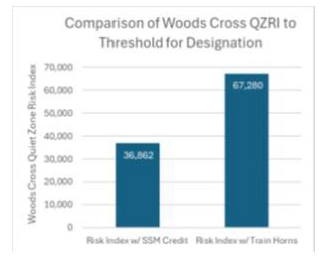
October 25, 2024:
On Thursday, October 24th, Woods Cross representatives held a virtual meeting with North Salt Lake City, Salt Lake City, and Utah Transit Authority representatives to discuss the status of projects in the Woods Cross Quiet Zone and efforts with the FRA to remove the temporary suspension.
Only Two Deficiencies Remain: The North Salt Lake Main Street and Salt Lake City 1000 West crossings are the last two deficiencies remaining (see Oct. 8 item c). The FRA inspectors have confirmed that as of Tuesday, Oct. 22nd, all other crossings in the Quiet Zone are in compliance.
What are North Salt Lake and Salt Lake City doing? Both cities immediately began efforts to make the corrections at each crossing as soon as they were notified. Because the work includes moving or installing arms, signals, equipment; and requires close coordination and approval with Union Pacific and other agencies, this work may take months to complete. Both cities have committed the money and manpower to complete the work they are responsible for and are asking for the cooperation and expedited services from others who are involved in the process. In the meantime, temporary safety measures will be implemented to request a prompt reinstatement of the Quiet Zone.
Can something be done to stop the train horns now? During the October 8th meeting with the FRA, the cities asked if alternative safety measures can be implemented immediately to reinstate the Quiet Zone (see Oct. 8 c-e below). North Salt Lake and Salt Lake City are preparing proposals to submit to the FRA in the form of a "waiver"' and we have requested a meeting with the FRA next week to evaluate these proposals informally so that we feel confident that they can be approved at the next FRA waiver meeting (TBD).
October 8, 2024:
This document is a chronological summary by the Woods Cross City Administrator, Bryce Haderlie of the activities relating to the Woods Cross Quiet Zone temporary suspension enacted by the Federal Railroad Administration (FRA) on September 30, 2024. This document is intended for public dissemination to answer questions relating to this subject.
What is happening with the Quiet Zone temporary suspension?
- On Monday October 7th, city representatives from Woods Cross (WX), North Salt Lake (NSL), and Salt Lake City (SLC) met via Zoom with the FRA, Utah Transit Authority (UTA), Union Pacific Railroad (UPR), Utah Department of Transportation (UDOT), and Parametrix (Railroad safety contractor) representatives to discuss the temporary suspension and efforts to reinstate the Quiet Zone.
During that meeting, the following information was shared:
- Layton City is correcting median heights at the Hill Field and Gentile St. crossings next week and anticipate being in compliance by Oct.16th .
- Salt Lake City was correcting a median height deficiency on Oct. 7th and anticipated being in compliance by Oct. 10th.
- NSL and SLC are in the process of designing and obtaining approvals to correct a crossing in each city that relates to signal and gate arm locations at crossings with the main lines and a spur line. NSL learned of the Main Street deficiency in April 2024 and SLC learned of the deficiency in June of 2024. The scope of these projects can take 18 months to design and construct due to the coordination and approval process with multiple agencies, contractors, and the FRA. WX asked the FRA if the quiet zone can be reinstated by creating short-term safety alternatives until the construction is complete at these two crossings. The FRA said that they are willing to consider short-term proposals from NSL and SLC if they meet the regulations.
- The FRA explained that strict regulations govern the authorization and/or suspension of the Quiet Zone designations and that all crossings must be in compliance or have authorized waivers before they can reinstate the Quiet Zone. UTA, UDOT and UPR are all committed to assist the cities in obtaining compliance. Cities were reminded that project plan reviews and work scheduling is dependent on other projects in the que. City representatives asked for plan reviews and work to be expedited as much as possible. Each city/agency responsible for crossings in the Quiet Zone will submit a letter/email notifying WX that the work is done. To expedite the process, the FRA has agreed to schedule inspections as quickly as possible to confirm compliance.
- WX cannot submit a Letter of Affirmation (letter confirming compliance) until 100% of the deficiencies comply with the Quiet Zone regulations or are given authorized waivers. It was also explained that a waiver request can take 2-3 months for the FRA to review and decide to approve or deny the application. All parties agreed to explore possible short-term safety measures to restore the Quiet Zone as quickly as possible, if it complies with the FRA regulations.
Other important information regarding the Quiet Zone includes:
- While it is called the “Woods Cross Quiet Zone” (extending from Ogden to SLC), Woods Cross cannot impose fines or legally compel any city or agency to correct crossing deficiencies. The Quiet Zone was enacted through voluntary agreements between SLC, NSL, Woods Cross, West Bountiful, Kaysville, Layton, Clearfield, Sunset, Clinton, Roy, Ogden, Harrisville, Pleasant View, and UTA. Woods Cross has accepted responsibility to compile the information and submit a Letter of Affirmation (letter of compliance) to the FRA on behalf of all cities in the Quiet Zone on a three- year cycle.
- When the current Woods Cross staff learned of the Quiet Zone responsibilities in 2021 through a letter from the FRA, we immediately engaged with the cities/agencies to ensure compliance of the crossings. It should be noted that some standards have been updated since 2008, and some compliance issues were not identified by the FRA until 2024.
October 4, 2024:
On Friday October 4, 2024, City Administrator, Bryce Haderlie held an interview with Fox 13 reporter, Mya Constantino to discuss the temporary suspension of the Woods Cross Quiet Zone. These are some of the questions that were asked.
What are we doing about it?
- Woods Cross is coordinating with the three cities that have the 4 remaining deficiencies to resolve them as quickly as possible. City representatives believed that extensions would be granted by the FRA (Federal Railroad Administration) to complete this work without interrupting the Quiet Zone designation. We are trying to understand why those deadline extensions are not being honored.
- Two crossings will be completed and compliant by Oct. 16th.
- The other two cities with those crossings are working with Union Pacific to get permits and start the work as soon as possible.
What are the next steps?
- We are working to schedule a meeting with the Washington DC FRA representatives to agree on solutions for those crossings and how we can satisfy those requirements in the short term and permanently.
What are a couple of possible solutions for a case like this?
- As soon as they can meet with us, we will be asking the FRA what solutions they will be willing to accept.
- Each of the three cities are committed to being in compliance. The time that it takes to approve plans and obtain permits through Union Pacific and UTA to work in the rail right-of-way is our biggest hurdle. We have not been told how long that will take.
Why and how do you think the conditions in the City of Woods Cross got to this point?
- The conditions are not in Woods Cross City, there are no noted deficiencies at any of the crossings in Woods Cross.
- Because Woods Cross is the agency that manages the Quiet Zone, we are responsible for coordinating with all of the cities and agencies that have crossings between Ogden and Salt Lake City.
- While local FRA representatives have been very accommodating with deadline extensions, the September 30th FRA letter indicated that there are “deadlines stretching into 2025 and 2026 for remediation of certain jurisdictions within the Woods Cross Quite Zone.” We intend to ask the FRA why those 2025 and 2026 extensions are not being honored to complete the work identified above.
- We are working with the FRA and the cities/agencies that the railway goes through to maintain compliance with the regulations.
October 1, 2024:
In 2008, the cities from Ogden to Salt Lake City cooperatively established the “Woods Cross Quiet Zone” through the Federal Railroad Administration (FRA).
Each agency with a street crossing the tracks is responsible for keeping the crossing in compliance with the Quiet Zone regulations.
As the sponsor agency, Woods Cross has been working with the agencies to maintain compliance with FRA regulations.
On September 30, 2024, the FRA issued a temporary suspension of the entire quiet zone, noting “that routine locomotive horn sounding must be initiated at these crossings . . . and will continue sounding until the quiet zone is compliant.”
As of Oct. 1st, four out of over 80 crossings were still working to gain compliance or obtain waivers. We are working with those cities and the FRA to reinstate the quiet zone as soon as possible.
PDF - Woods Cross Response to Quiet Zone Suspension (Updated 10-25-2024)
Posted 10/9/2024
Updated 10/25/2024
______________________________
This week, the federal rail authority (FRA) issued a finding removing the quiet zone designations along the railroad tracks between Ogden and Provo. By law, the FRA requires trains to sound their horns at all road crossings, unless sufficient safety measures (signs, paint, concrete medians etc) are in place at each crossing to qualify for a quiet zone. If a quiet zone designation is approved, the safety measures are deemed sufficient enough to prohibit the use of the horns at the crossings.
Kaysville is located within the “Woods Cross” quiet zone (established in 2008), which stretches from Ogden to Salt Lake, and last spring the FRA started working with all of the Cities in the zone to evaluate their crossings, identify deficiencies and provide a timeline to correct any deficiencies. The FRA inspections found that several dozen crossings in this zone had deficiencies that must be remedied to keep the quiet zone designation. All of the deficiencies were corrected except for 4, none of which are in Kaysville. While the sole crossing in Kaysville (Old Mill Ln) is compliant, because there are non-compliant crossings within our same zone, the FRA will require the train horns to be used at all crossings until the remaining deficiencies are addressed. The City is currently working with other Cities to evaluate options to best restore this as quickly as possible, but we don’t know how quickly that will happen and we apologize for the inconvenience and impact while this is being resolved.
Posted 10/2/2024